Pelagix underwater docking station for resident AUV operations
PelagiX水下对接站通过声学-光学组合导引技术将自主水下航行器引导至海底泊位,可实现超过90%的对接成功率且对接时间不超过30分钟;随后通过非接触式接口以不低于80%的效率为电池充电,并以不低于2Mbps的速率传输数据,可在无需回收航行器的情况下实现长期驻留作业和持续水下监测。
2026/11/25
Reading volume: 0
News Details
The battery has always been one of the greatest limitations in autonomous underwater surveying: sooner or later the vehicle has to surface, and every recovery cycle costs vessel time, weather windows and crew hours. The PelagiX underwater docking station is built to overcome this limitation. Designed for the PelagiX AUV product line, the station guides the vehicle to a subsea berth using combined acoustic and optical guidance, then recharges its batteries and receives its data without the vehicle ever being recovered — the core enabler of resident AUV operations and persistent underwater monitoring programs.
Why Docking Changes the Economics of AUV Operations
A conventional AUV operates in cycles: dive, survey, surface, recover, recharge, redeploy. Each cycle consumes deck crew time and, in offshore operations, keeps a support vessel on station. Industry analysis of resident vehicle programs points to the same conclusion from multiple directions: vehicles that can dock, recharge and offload data on the seabed reduce vessel days, continue operations through weather conditions that stop deck operations, and maintain persistent presence at monitoring sites.
The PelagiX docking station directly addresses this operating model. Once the station is installed on the seabed or deployed at depth, the AUV can return to it between missions to recharge and upload survey data, then resume its task list — extending underwater endurance from a single-battery sortie to continuous, multi-mission deployment.
Acoustic-Optical Guidance for Reliable Autonomous Docking
Docking is the most difficult maneuver an AUV performs, and the PelagiX station is designed to make it routine. The system uses combined acoustic-optical homing: an acoustic guidance sonar brings the vehicle in from long range, and four dedicated guidance lights take over for the final approach, where optical cues provide the precision needed for the vehicle to enter the docking funnel. The station's enclosed (funnel-capture) hull structure securely accommodates the vehicle once inside, holding it aligned with the charging and communication modules throughout the docking process.
Verified performance figures give buyers clear specifications to reference:
- Docking success rate: above 90%
- Docking process duration: under 30 minutes
- Non-contact underwater charging efficiency: no less than 80%
- Non-contact underwater data transfer rate: no less than 2 Mbps
The non-contact design is as important as these performance figures. Without wet-mate connectors that need alignment, seating or are prone to corrosion, the charging and data interfaces avoid the mechanical wear points that conventional contact-based subsea connectors accumulate over repeated docking cycles.
Flexible Installation: Seabed-Mounted or Floatable
The station supports two installation modes — placed directly on the seabed, or deployed as a floatable (subsurface suspended) configuration. This allows operators to adapt the station to the site: a fixed berth next to port infrastructure, a reservoir intake or an aquaculture site on the seabed, or a suspended station positioned in the water column where a floating or mid-depth reference point better suits the mission profile. Sensor equipment includes four guidance lights, acoustic guidance sonar, and non-contact charging and communication modules.
Resident Operations with the PelagiX AUV Line
The docking station is custom-developed for the PelagiX AUV series, and this resident combination naturally integrates with the company's long-endurance hulls. The AUV-533, with a standard endurance of at least 90 hours (extendable to 180 hours or 1,000 km with custom battery configurations) and 0.3% navigation accuracy with SLAM, is designed for multi-AUV swarm surveys and polar water missions. The AUV-900, the largest hull at 900 mm diameter and 6 m length, has a 250 kg payload capacity and reaches a custom endurance of up to 270 hours or 1,500 km with 0.2% navigation accuracy.
In resident deployment, the operating model changes: the vehicle conducts survey missions from the station, returns to recharge and upload data at ≥2 Mbps, receives updated mission plans, and undocks again — with surface support required for maintenance and task changes rather than for every mission cycle. Field observations collected during resident missions can also be fed into the OceanX-Eddy ocean environment forecasting model to support route planning that accounts for strong current regions.
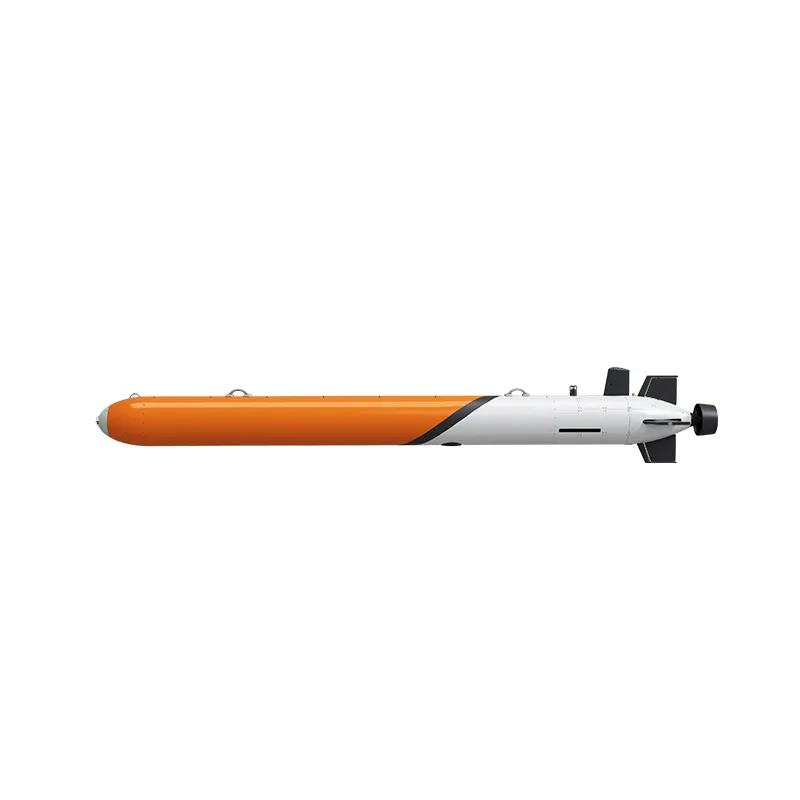
Launch and Recovery: A Containerized LARS for Deck Operations
When missions require deck-based launch and recovery, PelagiX provides a matching launch and recovery system (LARS) for large AUVs. The complete unit integrates into a standard shipping container for convenient deck installation, with dimensions of 5 m × 1.2 m × 1.5 m, a weight of 3 tons, 380 V power supply and 5.5 kW power consumption. It handles vehicle diameters from φ324 to φ900 mm in sea states below force 6, and operates fully automatically: the vehicle is released for launch, and upon return the system deploys a guide cable that the vehicle connects to for autonomous recovery.
This automation has a direct impact on staffing — reducing deck personnel from 8–10 to 1–2 — while minimizing human exposure during offshore handling and ensuring reliable recovery in marginal weather conditions where manual operations are least safe.
Where Docking-Based Operations Apply
Resident docking operations are configured for civil monitoring and survey tasks, including:
- Port and nearshore infrastructure monitoring: recurring inspection patrols from a fixed seabed berth without repeated vessel mobilization.
- Aquaculture sites: continuous monitoring of cage nets, moorings and site conditions, with the vehicle returning to dock between passes.
- Dam and reservoir inspection: repeated structural and sediment surveys in enclosed waters where docking shortens turnaround time.
- Offshore survey campaigns: long-duration mapping and monitoring programs where docking extends effective endurance beyond a single battery charge.
- Environmental and oceanographic observation: persistent presence at monitoring grids, with data uploaded at every docking cycle.
Availability and Configuration Support
The PelagiX underwater docking station is supplied together with the company's AUV platforms, launch and recovery systems and control software, with OEM, ODM and system integration support covering site-specific installation concepts, vehicle-station matching and communication integration. The AUV-600 product page provides a configuration example of the PelagiX AUV product line, and complete product information is available at pelagix-tech.com, where buyers can request configuration discussions for specific resident operation programs.
Share to:


