Choosing an Autonomous Underwater Vehicle (AUV) can be a daunting task, especially when faced with the myriad of options available in today’s market. Whether you are a defense contractor, a marine researcher, or involved in offshore industries, understanding key parameters such as depth rating, endurance, navigation capabilities, and payload capacity is crucial. This guide aims to simplify the process and help you make an informed decision.
A Practical Selection Guide for Autonomous Underwater Vehicles: How to Weight Mission Profile, Depth Rating with Margin, Endurance Converted to Line-Kilometres, Navigation Accuracy as Percentage of Range, Payload Compatibility, Launch-and-Recovery Systems and Resident Docking Support — With PelagiX AUV-533/600/900 Specifications as Worked Examples
2026/11/25
Reading volume: 0
News Details
Choosing an autonomous underwater vehicle is a systems decision, not a spec-sheet comparison. Two AUVs with similar depth ratings and headline endurance can behave very differently on the survey line, because real performance depends on how the mission profile, the navigation suite, the payload and the deck logistics fit together. This guide walks through the selection dimensions that matter most when specifying an AUV for civil survey, inspection and research work — and uses PelagiX platform figures as worked examples of how each dimension translates into buyer-facing specifications.
Start with the Mission Profile, Not the Catalogue
The single most common selection mistake is matching peak numbers to a loosely defined task. Different missions weight the same specifications differently:
- Bathymetric mapping: navigation accuracy and multibeam integration dominate; depth matters only as far as the survey area requires.
- Deep-sea exploration: depth rating and endurance dominate; payload flexibility decides how many objectives a single campaign can cover.
- Environmental monitoring: repeatability, data management and deployment logistics dominate over peak performance.
- Multi-vehicle programmes: swarm coordination, communication switching and common ground-station tooling join the checklist.
Write the mission profile down in numbers — survey area, line spacing, required position accuracy, revisit frequency, distance from support — before comparing vehicles. Every later trade-off should be tested against that profile.
Depth Rating: Match the Hull to the Water, with Margin
Depth is the first hard filter, and the standard practice is to keep a margin: a vehicle rated for the maximum working depth alone leaves no room for sea-state, sensor offsets and contingency descents, so buyers commonly specify a rating comfortably above their deepest site. Configurable depth options make this easier to buy intelligently. PelagiX, for example, offers the AUV-533 in 2000 m and 6000 m hulls, the AUV-600 in 1000 m, 3000 m and 6000 m versions, and the AUV-900 in 3000 m, 4500 m and 6000 m — so a programme working at 800 m does not pay for a 6000 m titanium pressure architecture it will never use. At the deep end, construction quality matters as much as the number: titanium housings, syntactic foam buoyancy, double O-ring sealing with vacuum leak testing, and hyperbaric testing above the rated depth are the verification points to ask about.
Endurance and Speed: Convert the Specification into Line-Kilometres
Endurance is always quoted at a rated speed, and the rated speed is what turns hours into usable coverage. At a 3-knot survey speed, one hour equals roughly 5.5 km of line; the same vehicle sprinting at 6 knots covers distance faster but burns battery disproportionately. When comparing vehicles, convert each vendor's endurance figure into line-kilometres at your planned survey speed, and ask whether the figure assumes your payload's power draw.
Worked examples from the PelagiX line: the AUV-600 provides 24 hours of standard endurance for daily-cycle grid missions; the AUV-533 runs at least 90 hours, extendable to 180 hours or 1000 km with custom battery configurations; the AUV-900 reaches 270 hours or 1500 km. The AUV-533's custom range also supports surveys that begin and end at different ports — a logistics capability that matters more than any single spec for remote campaigns. Cruise envelopes across the series run 1–6 knots, which should be checked against the currents at the survey site.
Navigation Accuracy: The Number That Defines Your Deliverable
For mapping work, navigation accuracy is the specification that decides whether the data is chart-grade. Look for a full navigation stack — INS, DVL, GNSS and USBL as the baseline — and treat accuracy quoted as a percentage of distance travelled as the comparable figure across vendors. PelagiX specifies 0.5% of range for the AUV-600, 0.3% with SLAM for the AUV-533 and 0.2% with SLAM for the AUV-900; in practice, 0.2% over a 15 km survey line means roughly 30 m of drift, which is the kind of arithmetic buyers should run on every quotation. Ask also about failure behaviour: bottom-lock DVL operation at survey altitude, automatic return-to-home if the acoustic link is lost, and vision-guided docking as a recovery fallback are the mechanisms that turn a good navigation number into a reliable field result.
Payload Compatibility: Sensors, Interfaces and Power
An AUV is worth what its sensors deliver, so payload compatibility deserves as much scrutiny as the hull. The practical questions are: which sensors are supported (not just "custom payloads available"), how many physical interfaces and how much payload power are provided, and whether payload bays can be reconfigured between missions. The PelagiX large-AUV line, for instance, accepts modular integration of CCD cameras, CTD sensors, altimeters, obstacle-avoidance sonar, side-scan sonar, multibeam sonar, sub-bottom profilers, USBL and hydrophones, with payload capacity scaling across the range — 150 kg on the AUV-533 and 250 kg on the AUV-900. List your planned sensor models with their power draws and data rates, and confirm them against the vehicle's interfaces before shortlisting.
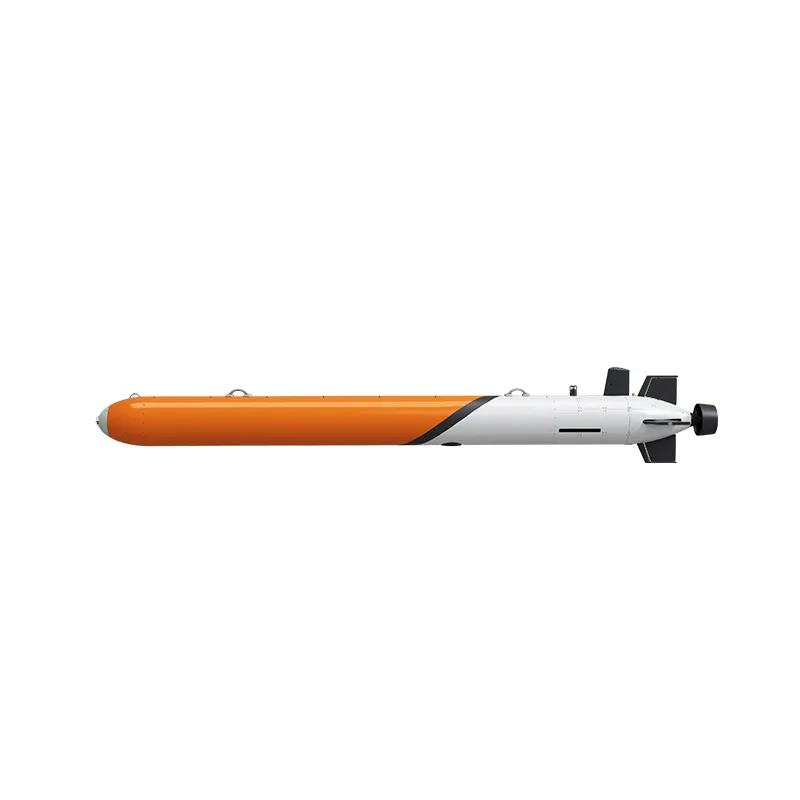
Payload compatibility — sensors, interfaces and power — often decides mission value more than hull size; the PelagiX AUV-600 shown here accepts a modular survey payload set.
Launch, Recovery and Resident Support: The Deck-Side Half of the System
A vehicle that cannot be launched and recovered reliably costs more than it surveys. Check three things. First, the launch-and-recovery system: PelagiX pairs its large hulls with a containerized, fully automated LARS (5 m × 1.2 m × 1.5 m, 3 tonnes, 380 V / 5.5 kW) covering vehicle diameters from φ324 to φ900 mm in sea states below force 6, cutting deck crews from 8–10 people to 1–2. Second, resident capability: an underwater docking station with acoustic-optical guidance, non-contact charging (≥80% efficiency on the PelagiX station) and data transfer (≥2 Mbps) converts endurance limits into continuous presence for monitoring programmes. Third, communications: multi-channel switching across UHF, WiFi, 4G and underwater acoustics keeps a workable link through the whole mission envelope, which matters doubly for multi-vehicle operations.
Software and Data Workflow
The last selection dimension is the one buyers most often leave unexamined: the software around the vehicle. Mission planning should offer a visual interface for route editing; the ground station should present real-time vehicle state, warnings and progress; and the control software should support secondary development if your team plans custom autonomy or data pipelines. PelagiX supplies in-house control software across its AUV line with these capabilities, alongside the OceanX-Eddy ocean-environment forecasting model for route planning in strong-current regions — an example of how environmental intelligence is becoming part of the AUV package rather than a separate procurement.
A Ten-Point Selection Checklist
- Mission profile in numbers: survey area, line spacing, accuracy requirement, revisit cycle, support distance — written down before comparing vehicles.
- Depth rating with margin: configurable depth options matched to actual site depth, plus housing test and verification practices.
- Endurance converted to line-kilometres at your survey speed and payload power draw, not the vendor's rated speed alone.
- Navigation stack and accuracy: INS+DVL+GNSS+USBL as baseline, percentage-of-range accuracy, SLAM where mapping deliverables demand it, and defined link-loss behaviour.
- Payload compatibility: named sensor support, interface count, payload power, and between-mission reconfiguration.
- Launch and recovery: containerized LARS, sea-state limits, crew requirements.
- Resident options: docking, non-contact charging and underwater data transfer if persistent monitoring is on the roadmap.
- Communications: multi-channel switching and ground-station integration.
- Software: visual mission planning, secondary-development support, environmental data services.
- Supplier support: OEM/ODM flexibility, sensor integration service, and configuration help for the specific programme.
PelagiX supplies the AUV-533, AUV-600 and AUV-900 platforms together with LARS, underwater docking stations, control software and full OEM/ODM configuration support for civil survey, inspection and research programmes. The full product range is listed at pelagix-tech.com, where buyers can submit a mission profile and request configuration guidance matched to it.
Share to:


 can be a daunting task, especially when faced with the myriad of options available in today’s market. Whether you are a defense contractor, a marine researcher, or involved in offshore industries, understanding key parameters such as depth rating, endurance, navigation capabilities, and payload capacity is crucial. This guide aims to simplify the process and help you make an informed decision.)


